Fosi Audio – Compact Amplifiers for Sim Racing and Tactile Feedback
Fosi Audio is a manufacturer of compact audio electronics, specialising in Class D amplifiers, Hi-Fi equipment and home audio solutions. Thanks to their small size, energy efficiency and straightforward operation, the brand's products are also suitable for racing and flight simulation setups.
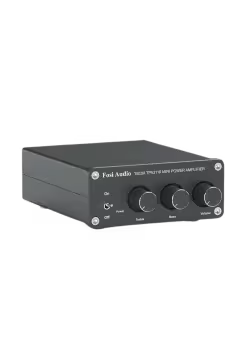
The Fosi Audio range at Simline.eu includes the Fosi Audio TB10A, a two-channel stereo amplifier designed for passive speakers and tactile transducers. It can be used to build a haptic feedback system that allows drivers to feel engine vibrations, road surface details, ABS operation and other simulator effects through their cockpit.
Fosi Audio TB10A – Two Channels and Up to 2 × 100 W
The Fosi Audio TB10A uses a Texas Instruments TPA3116D2 amplifier chip operating in Class D. It features two independent stereo channels and supports speaker or transducer loads between 2 and 8 ohms.
The manufacturer specifies a maximum output of up to 2 × 100 W into 4 ohms. This is a maximum rating rather than guaranteed continuous output from both channels simultaneously. Actual performance depends on the connected load, signal level and the included 24 V / 4.5 A power supply.
The compact aluminium housing measures 130 × 100 × 35 mm, allowing the amplifier to be placed beside a racing cockpit, beneath a desk or near a simulator seat.
Front-panel controls include volume, bass and treble adjustments, making it easy to modify the output without opening additional software.
Why Use an Amplifier with Bass Shakers?
Bass shakers are tactile transducers that convert an amplified audio signal into mechanical vibration. When mounted to a racing seat, pedal deck or aluminium-profile cockpit, they can provide physical feedback about the simulated vehicle.
In racing simulators such as iRacing, Assetto Corsa Competizione and Automobilista 2, software such as SimHub can generate effects from supported game telemetry. Depending on the simulator and configuration, these can include engine RPM, gear changes, kerb strikes, wheel slip, ABS intervention and road surface information.
The Fosi Audio TB10A amplifies the audio signal from the computer and delivers it to connected bass shakers. The amplifier itself does not read game telemetry, so compatible software and an audio output are required to generate the effects.
Fosi Audio TB10A with Xcite Bass Shakers
The TB10A is compatible with several 4-ohm Xcite tactile transducers available at Simline.eu. Different models provide varying levels of vibration output, allowing the system to be adapted to the cockpit's size and intended mounting location.
The Xcite XBS25-4 is a compact transducer suited to localised haptic feedback. It can be installed near the pedals, beneath a seat or on other rigid cockpit components where a larger shaker might not fit. The amplifier output should be adjusted carefully to suit its power rating.
For stronger feedback, the Xcite XBS50-4 offers greater mechanical output, making it suitable for racing seats and larger cockpit structures. A practical configuration uses two transducers, with one connected to each TB10A channel.
The range also includes the Xcite XBS100-4, designed for more demanding tactile installations. The TB10A can drive this transducer at moderate levels, although a more powerful amplifier would be required to use its full performance capabilities.
Dayton Audio BST-1 and BST-2 Compatibility
The Fosi Audio TB10A can also be combined with popular Dayton Audio tactile transducers. Both the BST-1 and BST-2 have a nominal impedance of 4 ohms, making them electrically compatible with the amplifier.
The Dayton Audio BST-2 delivers 35 W RMS and features a relatively compact construction. It is suitable for a first tactile feedback installation or a multi-zone setup with separate effects for the seat and pedals.
The larger Dayton Audio BST-1 has a 50 W RMS power rating and is frequently used beneath sim racing seats. It can reproduce stronger low-frequency effects, including engine vibration, road impacts and gear-change feedback.
For both transducers, begin with a low output level and increase the intensity gradually. The amplifier is capable of delivering more power than the transducers' nominal ratings under some conditions, so proper output adjustment is essential.
How to Connect Fosi Audio TB10A to SimHub
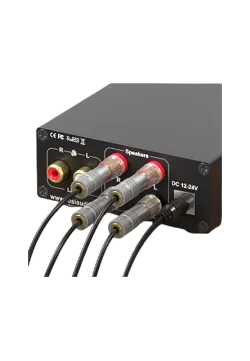
The Fosi Audio TB10A uses an analogue stereo RCA input. It does not have a built-in USB sound card, Bluetooth connectivity or a digital audio interface.
To connect it to a computer, you need a suitable line output from an internal sound card or external audio interface. An RCA cable carries the audio signal to the amplifier, which then drives the connected bass shakers using speaker cables.
In SimHub, the ShakeIt Bass Shakers feature can be configured to send telemetry-based effects to the selected audio device. Individual effects can then be assigned to separate left and right channels.
For example, one channel can reproduce seat vibrations while the other handles pedal-related effects. This allows drivers to distinguish different types of feedback more easily.
It is also worth configuring a low-pass filter in SimHub or another suitable audio-processing application to limit unnecessary high-frequency signals. The TB10A's bass adjustment does not replace a dedicated low-pass filter.
Two Independent Channels for Seat and Pedal Feedback
One of the main advantages of the TB10A is its two-channel design. A simple installation can use one bass shaker beneath the racing seat and another mounted to the pedal deck.
The seat transducer can reproduce engine vibration, road texture and kerb strikes, while the pedal-mounted unit can provide more localised effects related to ABS operation and wheel lock-up.
This separation can provide more useful feedback than a single transducer reproducing every effect through the same part of the cockpit.
The connected transducers must remain within the amplifier's supported impedance and power requirements. For a straightforward installation, using one 4-ohm bass shaker per channel is a practical choice. Do not bridge the outputs or connect their negative terminals together unless the manufacturer explicitly supports that configuration.
Fosi Audio for Desktop and Home Audio Systems
Although the TB10A works well as a bass shaker amplifier, its primary purpose is conventional audio amplification. It can power compatible passive speakers in desktop setups, home stereo systems and multimedia installations.
The RCA input accepts line-level audio from a suitable source, while the front-panel bass and treble controls allow listeners to adjust the sound to their preferences.
Its Class D architecture combines relatively high efficiency with compact dimensions, making the TB10A a practical option where a full-size audio amplifier would take up too much space.
As a result, the same amplifier model can be used in a traditional speaker setup or a dedicated sim racing tactile feedback installation.
Is Fosi Audio TB10A Right for Your Sim Racing Setup?
If you are planning a tactile system with one or two 4-ohm bass shakers, the Fosi Audio TB10A is worth considering. It offers independent stereo channels and compatibility with several popular Xcite and Dayton Audio transducers.
Before ordering, check the shaker's nominal power, impedance, mounting requirements and available audio connections. You will also need suitable RCA and speaker cables, along with mounting brackets if required.
The standard package includes the TB10A amplifier, a 24 V / 4.5 A power supply, an AC power cable and a user manual. Bass shakers, speaker cables, an external sound card and mounting accessories must be selected separately.
Explore the Fosi Audio TB10A at Simline.eu and browse the available bass shakers to build a tactile feedback system for your racing simulator. Additional technical information is available on the official Fosi Audio website.
Less

 English
 Polski