
Shopping Cart
There are no more items in your cart
 English
  Polski
- Buyer's guides
- 0 likes
- 672 views
- 0 comments
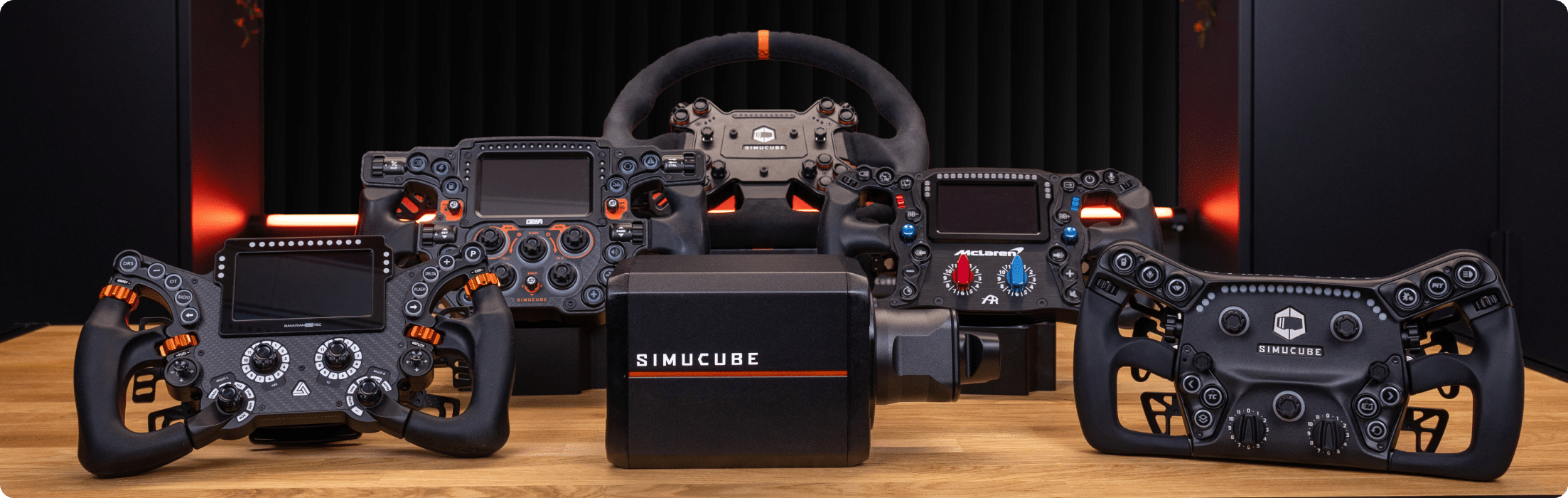
Simucube 3 Sport, Pro or Ultimate? Direct Drive Wheelbase Comparison
A practical comparison of Simucube 3 Sport, Pro and Ultimate, covering torque, Max Torque Slew Rate, motor design, mounting, ecosystem changes and the type of sim racing rig each model suits best.
Author: Simline.eu team
Technical review: Simline.eu sim racing hardware team
Last updated: June 19, 2026
Report a data issue: Simline.eu contact form
Simucube has earned a strong reputation in sim racing. The reason is not just power. Its main strength is clean and fast force feedback. The wheelbase can deliver a lot of information without burying useful detail under noise. That makes it easier to read grip, tyre load and the first signs of a slide.
The Simucube 3 range includes three main models: Simucube 3 Sport, Simucube 3 Pro and Simucube 3 Ultimate. Sport produces 15 Nm, Pro 25 Nm and Ultimate 35 Nm.
Those numbers do not tell the whole story. Motor design, response speed and control quality matter as well. So do Torque Slew Rate, wheel weight and the force feedback profile. Each model therefore suits a different kind of rig.
In brief
Sport is the sensible choice for most users. Pro offers more headroom and works better with heavier steering wheels. Ultimate is aimed at no-compromise or professional setups.
A useful comparison has to separate three things: maximum torque, response speed and the quality of motor control. Together, they show how the wheelbase behaves in a long corner, during a sudden countersteer and through a small steering correction. This is why a simple Nm comparison can be misleading, especially across different generations. Simucube 3 was designed so that all three models keep a similar level of precision, even though their torque reserves are very different.
How was this comparison prepared?
This article is a buying guide. It combines data from official Simucube documentation with the Simline.eu team's experience in selecting hardware, checking compatibility and configuring sim racing rigs.
Numerical values such as maximum torque, Torque Slew Rate, encoder type, power supply rating, weight and dimensions come from manufacturer materials. Comments about model choice, steering wheel weight, clipping headroom and value are Simline.eu editorial assessments.
This is not a laboratory test performed by Simline.eu. We are not publishing our own measurements of noise, temperature, latency or the full torque curve. When we discuss how a wheelbase may feel, we separate manufacturer data from practical conclusions for the user.
Criteria used in this guide
- maximum torque and headroom before clipping,
- Max Torque Slew Rate and response to short signals,
- smoothness and the absence of noticeable cogging,
- the effect of steering wheel diameter and weight,
- mounting, Quick Release design and compatibility,
- upgrade options and the cost of the full ecosystem,
- suitability for home use, league racing and professional rigs.
Commercial disclosure
Simline.eu sells some of the products described and linked in this article. Store links do not change the customer's price. We also discuss brands that are not part of our current range, so the reader can compare a wider section of the market.
Why is Simucube held in such high regard?
Wheelbase power matters, but it is not everything. Two bases may produce the same peak torque and still feel very different. One may be smooth and immediate. The other may add more noise, delay or filtering.
Simucube focuses on a clear signal. You can feel kerbs, but also smaller changes in tyre load. The first signs of front-end washout are easier to catch. Weight transfer is also easier to read. This can improve immersion, but it may also help with consistency over a full stint.
Good force feedback does not need to be brutal. It should give useful information at the right time. Strong effects should not hide the smaller ones.
Consistency is especially important. A driver quickly learns how a steering system normally behaves. If the wheelbase reacts in a repeatable way, it becomes easier to tell a setup problem from a real change in grip. Stable behaviour also matters during long sessions, when the motor and power electronics remain under load. A good wheelbase should not suddenly lose detail or change character without a clear reason.
Cogging torque: what is it?
When comparing Direct Drive motors, it is worth understanding cogging torque. It is easiest to notice when the shaft turns very slowly. Instead of perfectly smooth movement, the driver may feel small steps or a faint notching effect.
Cogging comes from the interaction between the rotor magnets and the stator geometry. At high speed the effect may be less obvious. During a small correction, however, it can add unwanted texture to the signal.
Simucube wheelbases are known for very smooth movement. The manufacturer describes the system as having no noticeable cogging or notching. In practice, slow steering corrections feel even, and the wheel does not appear to jump between artificial positions.
This is difficult to judge from a specification table. The clearest comparison comes from turning two wheelbases slowly, one after another. During driving, a smooth motor helps preserve the smallest changes in the signal.
Low cogging is especially useful in cars with light steering, where any artificial step is easy to notice. In a heavy GT car, the same effect may be partly hidden by higher steering load, but it still affects fine corrections. Simucube reduces these disturbances through both motor design and precise current control. As a result, mechanical texture is less likely to compete with the information coming from the simulation.
Motor, encoder and control system
Sport and Pro use SPM motors. Ultimate uses a different spoke-type IPM motor. Every model has a 23-bit absolute encoder, which provides more than eight million positions per revolution. That high resolution supports smooth and precise movement.
The encoder alone does not create good force feedback. The controller, firmware, filters and the signal from the game all matter. Simucube combines those elements into one control system.
The encoder reports shaft position, but the control algorithm still has to calculate the current needed to produce the requested torque. If the regulation is too slow, the wheel may respond late or lose short impulses. If it is too aggressive, it may introduce oscillation that does not come from the game's physics. This balance is one reason why encoder resolution cannot be used as the only measure of quality.
Max Torque Slew Rate: why Nm/ms matters
Most buyers look at Nm first. It tells you the maximum torque a wheelbase can produce. There is another important number: Max Torque Slew Rate, expressed in Nm/ms.
Slew rate describes how quickly torque can change. It is therefore not just a measure of strength. It also shows how fast the motor can respond to a short event.
A hard kerb strike is one example. A fast countersteer is another. Sudden loss of grip also matters. In these moments, the wheelbase has very little time to raise or reduce torque.
A value of 9.5 Nm/ms indicates a very fast possible change in torque. It should not be treated as a simple zero-to-maximum time. Filters, the game, wheel mass and the selected profile all affect the final result.
Maximum torque tells you how much force is available. Slew rate tells you how quickly that force can change. The two values should be read together.
Sport, Pro and Ultimate are all rated at 9.5 Nm/ms. This means that Sport can respond very quickly even though it produces 15 Nm. Pro and Ultimate add more torque headroom for stronger and longer loads.
For comparison, Simucube 2 Sport is rated at 4.8 Nm/ms, Simucube 2 Pro at 8.0 Nm/ms and Simucube 2 Ultimate at 9.5 Nm/ms. The new Sport therefore reaches the same maximum slew rate as the older Ultimate.
Using the highest possible slew rate is not always ideal. A very sharp profile can feel nervous, especially with a small and light Formula wheel. The setting should match the car, game and steering wheel.
A high hardware limit still gives useful freedom because the user can reduce it without removing the motor's underlying capability. A classic road car may feel more natural with a slower torque rise. A prototype or single-seater may benefit from sharper impacts and faster load changes. The best profile is not always the fastest one, but a good wheelbase should let the user choose.
The Simucube Link platform
The Simucube 3 range uses the Link system. Simucube Link Hub connects compatible equipment to the PC. One hub can handle several devices.
The new Simucube Link Quick Release carries both power and data. This removes unnecessary cables near the steering wheel and makes wheel changes quicker.
Link is useful when building a new rig because it can bring the base, wheel and other compatible parts into one system. It does not block the use of USB wheels. A third-party USB wheel can still connect directly to the PC.
For daily use, the main advantage is simpler wiring and one place to manage compatible hardware. This matters when a steering wheel has a display, lighting and many powered controls. Support for independent USB devices also leaves room for users who prefer third-party wheels. The ecosystem is convenient without forcing a complete hardware replacement.
Mounting and driving position
Every Simucube 3 wheelbase supports front and bottom mounting. This gives the user more options when designing the cockpit.
Bottom mounting can make wheel height easier to set and may help move the monitor closer. For front mounting, the Simucube Mount is one option.
Simucube 3 Sport: the sensible premium choice
Simucube 3 Sport produces 15 Nm. It is the most accessible model in the range, but it is not an entry-level wheelbase. It still offers premium build quality and a very fast response.
For many users, 15 Nm is enough. It allows a strong and clear profile while leaving room for kerbs and short impacts. There is no need to run the base at full power all the time.
Sport works well with light Formula wheels and medium-weight GT wheels. With a very heavy wheel, the remaining headroom becomes smaller. That is when Pro starts to make more sense.
Wheel diameter also changes the result. A larger rim creates a longer lever and usually feels softer at the hands. It also increases inertia. A small Formula wheel may feel extremely lively at 15 Nm, while a large rally rim asks more from the motor. This is why Sport should not be judged by peak torque alone.
Its 9.5 Nm/ms slew rate is another major strength. The base is not slow or soft. Short signals can still feel sharp and immediate.
Sport makes sense if:
- you are moving up from a 5–12 Nm wheelbase,
- you want premium force feedback without paying for unused torque,
- you use a light or medium-weight steering wheel,
- you do not drive with extreme force settings,
- you value clarity and fast response,
- you want to use the Link ecosystem.
Simucube 3 Sport specifications
- Maximum torque: 15 Nm.
- Motor: SPM.
- Max Torque Slew Rate: 9.5 Nm/ms.
- Encoder: 23-bit absolute.
- Power supply: 280 W.
- Mounting: front and bottom.
- Control Box: included.
- Link Hub: required.
Simucube 3 Pro: more headroom and 25 Nm
Simucube 3 Pro produces 25 Nm, which is 10 Nm more than Sport. It also uses a stronger power supply and is better suited to heavy steering wheels.
The extra torque is not only for driving with more force. It also protects short peaks in the signal. The wheel may already be heavily loaded in a corner, but Pro can still reproduce a kerb strike or sudden loss of grip.
This reduces the risk of clipping. Clipping occurs when the requested signal reaches the selected limit and cannot rise any further. Different strong events then begin to feel the same.
With Pro, the user can keep a strong baseline load while leaving more room for short peaks. This is useful in high-downforce cars, where steering load stays high through fast corners.
Pro also handles large GT rims, heavy hubs and display-equipped wheels more comfortably. The motor has more authority over the additional inertia.
Pro makes sense if:
- you want a large torque reserve,
- you use a heavy steering wheel,
- you prefer a strong FFB profile,
- you race in leagues or complete long sessions,
- you want one wheelbase that is unlikely to feel limiting later.
Simucube 3 Pro specifications
- Maximum torque: 25 Nm.
- Motor: high-response SPM.
- Max Torque Slew Rate: 9.5 Nm/ms.
- Encoder: 23-bit absolute.
- Power supply: 360 W, up to 450 W peak.
- Mounting: front and bottom.
- Control Box: included.
- Link Hub: required.
Simucube 3 Ultimate: 35 Nm and an IPM motor
Simucube 3 Ultimate is the top model in the range. It produces 35 Nm and uses a new spoke-type IPM motor. It is also larger and heavier than Pro.
The IPM motor has a different internal layout from the SPM motors used in Sport and Pro. It can provide high torque density, strong efficiency and very fast response while keeping the smooth character expected from Simucube.
Most users will not run 35 Nm continuously. The headroom still has a purpose. It can be useful with very heavy steering wheels, high sustained loads and professional or commercial equipment.
Ultimate is also aimed at rigs that operate for many hours and need repeatable behaviour under heavy load. This includes race teams, training centres, schools and public simulators. In that environment, motor efficiency and torque reserve matter more than they do in a short home session.
Ultimate makes sense if:
- you are building a professional or commercial simulator,
- you use a very heavy steering wheel,
- you want 35 Nm of torque headroom,
- the spoke-type IPM motor is important to you,
- you need consistent performance under sustained load,
- you do not want to make compromises on the wheelbase.
Simucube 3 Ultimate specifications
- Maximum torque: 35 Nm.
- Motor: spoke-type IPM.
- Max Torque Slew Rate: 9.5 Nm/ms.
- Encoder: 23-bit absolute.
- Power supply: 360 W, up to 450 W peak.
- Dimensions: 135 × 135 × 323 mm.
- Weight: 13 kg.
- Mounting: front and bottom.
- Control Box: included.
- Link Hub: required.
Does Ultimate make sense for a home rig?
It can, but not for everyone. Pro already offers a very large reserve. Ultimate is easier to justify with heavy equipment, long operating hours or a professional use case.
Simucube 3 Sport, Pro and Ultimate comparison
| Specification | Simucube 3 Sport | Simucube 3 Pro | Simucube 3 Ultimate |
|---|---|---|---|
| Maximum torque | 15 Nm | 25 Nm | 35 Nm |
| Motor | SPM | High-response SPM | Spoke-type IPM |
| Max Torque Slew Rate | 9.5 Nm/ms | 9.5 Nm/ms | 9.5 Nm/ms |
| Encoder | 23-bit absolute | 23-bit absolute | 23-bit absolute |
| Power supply | 280 W | 360 W, 450 W peak | 360 W, 450 W peak |
| Weight | 8.7 kg | 11.0 kg | 13.0 kg |
| Best suited to | Most advanced home users | Heavy wheels and stronger FFB profiles | Professional and no-compromise rigs |
All three models use the Link platform, a 23-bit encoder and a maximum slew rate of 9.5 Nm/ms. The main differences are torque, motor design, size, weight and intended use.
Sport offers the best balance for a typical home rig. Pro is easier to justify with a heavy steering wheel and stronger FFB. Ultimate makes the most sense when sustained load, inertia and professional use become central requirements.
Strengths and limitations of each model
| Model | Main strengths | Limitations | Best use case |
|---|---|---|---|
| Simucube 3 Sport | Fast slew rate, lower weight, lower entry cost and full Link support. | Less headroom with very heavy wheels and high sustained torque. | Home rigs, Formula, GT and rally wheels. |
| Simucube 3 Pro | 25 Nm, wide tuning range and strong clipping headroom. | Higher cost and more power than some users will need. | Heavy wheels, leagues, long races and strong FFB. |
| Simucube 3 Ultimate | 35 Nm, spoke-type IPM motor, high efficiency and large reserve. | Highest cost, greatest weight and need for a very rigid cockpit. | Professional, commercial and no-compromise simulators. |
A stronger model is not automatically better in every rig. A poorly tuned Pro or Ultimate can feel less informative than a well-configured Sport. FFB settings, steering wheel weight and mounting stiffness all influence the final result.
Steering wheel diameter and weight change the result
Manufacturer torque figures are measured at the shaft, but the driver feels force at the rim. A larger wheel creates a longer lever, so the same wheelbase may feel softer. Weight matters as well. A heavy display, metal hub and thick rim all increase inertia.
This is why two users can judge the same wheelbase differently even when using the same software profile. Sport with a light Formula wheel may feel more immediate than Pro with a very heavy GT wheel, although Pro still retains more torque headroom.
Simucube 2 or Simucube 3?
The previous generation remains very capable. Simucube 2 Sport produces 17 Nm, Simucube 2 Pro 25 Nm and Simucube 2 Ultimate 32 Nm.
The new Sport has 2 Nm less than the old Sport, but it reacts much faster on paper: 9.5 Nm/ms instead of 4.8 Nm/ms. That difference matters during short events.
The new Pro still produces 25 Nm. Its changes focus on the Link platform, the new Quick Release, bottom mounting and the updated Control Box.
Ultimate rises from 32 Nm to 35 Nm. The more important change is the move to the new spoke-type IPM motor.
Simucube 2 vs Simucube 3: full specification table
The table below compares all six models. It covers torque, slew rate, motor type, encoder, power supply, dimensions, weight, mounting and connection method.
| Model | Maximum torque | Max Torque Slew Rate | Motor | Encoder | Power supply | Dimensions with QR | Weight | Mounting | Connection and QR system |
|---|---|---|---|---|---|---|---|---|---|
| Simucube 2 Sport | 17 Nm | 4.8 Nm/ms | Direct Drive motor with very low torque ripple | 22-bit absolute | 280 W | 130 × 130 × 250 mm | 8.0 kg | Front mounting; horizontal mounting with a bracket | USB, Simucube Wireless Wheel, classic SQR |
| Simucube 3 Sport | 15 Nm | 9.5 Nm/ms | SPM optimized for Direct Drive | 23-bit absolute | 280 W | 135 × 135 × 278 mm | 8.7 kg | Front and bottom | Simucube Link Hub, Link Quick Release |
| Simucube 2 Pro | 25 Nm | 8.0 Nm/ms | High-response Direct Drive motor with very low torque ripple | 22-bit absolute | R2: 1 × 450 W peak | 130 × 130 × 270 mm | 11.1 kg | Front mounting; horizontal mounting with a bracket | USB, Simucube Wireless Wheel, classic SQR |
| Simucube 3 Pro | 25 Nm | 9.5 Nm/ms | High-response SPM | 23-bit absolute | 360 W, up to 450 W peak | 135 × 135 × 303 mm | 11.0 kg | Front and bottom | Simucube Link Hub, Link Quick Release |
| Simucube 2 Ultimate | 32 Nm | 9.5 Nm/ms | Maximum-response, low-inertia Direct Drive motor | 24-bit Hiperface | 1000 W | 115 × 115 × 310 mm | 11.3 kg | Front mounting through pass-through holes | USB, Simucube Wireless Wheel, classic SQR |
| Simucube 3 Ultimate | 35 Nm | 9.5 Nm/ms | Spoke-type IPM optimized for Direct Drive | 23-bit absolute | 360 W, up to 450 W peak | 135 × 135 × 323 mm | 13.0 kg | Front and bottom | Simucube Link Hub, Link Quick Release |
The largest generational jump is visible in Sport. Simucube 3 Sport has 2 Nm less peak torque than Simucube 2 Sport, but its maximum slew rate rises from 4.8 to 9.5 Nm/ms.
The Pro models share the same 25 Nm maximum torque. Simucube 3 Pro adds a faster slew rate, a 23-bit encoder, the Link platform and native bottom mounting. In the Ultimate range, maximum torque rises from 32 to 35 Nm and the new generation moves to a spoke-type IPM motor.
Simucube 2 connects directly to the PC over USB and uses the classic SQR system. Simucube 3 requires Link Hub, but it can transfer power and data through the new Link Quick Release.
If you already own Simucube 2 Pro and are happy with it, an upgrade is not urgent. The older wheelbase remains strong and precise. Simucube 3 is easier to recommend for a completely new rig, especially when the user wants Link Hub, Link QR and new-generation wheels from the start.
Power supply and stability during long sessions
Power supply rating does not translate directly into maximum torque, but it affects how the system handles repeated changes in load. Pro and Ultimate use stronger power electronics that better match their higher torque and heavier steering wheels.
A short test may not reveal much difference. A long race places more demand on the electronics and cooling. A stable wheelbase should keep the same character from the first lap to the last.
The motor does not work at maximum torque all the time. Good control reduces unnecessary heat, and the housing helps dissipate it. Even premium equipment still needs free airflow and solid mounting.
Older wheelbases can also use the Simucube 3 Quick Release Adapter for Simucube 2. It allows the new mounting system to be fitted to a Simucube 2 base, but it does not turn the old wheelbase into a full Link platform.
What parts are required?
Simucube Link Hub
Simucube 3 wheelbases require Simucube Link Hub. The hub connects compatible hardware to the PC. One hub can support several devices.
Simucube Link Quick Release
Simucube Link QR connects the steering wheel to the base and carries power and data. This removes the need for a separate cable near the wheel.
Mount and shaft extension
The Simucube Mount can be used for front mounting. A compatible cockpit bracket is another option.
The Simucube 3 Shaft Extension Kit moves the wheel farther away from the base. This can make it easier to place a monitor close behind the steering wheel.
Before ordering, measure the driving position, monitor distance and available space around the steering column. A powerful wheelbase also needs a rigid structure. Even small flex can remove part of the detail from the force feedback.
Other Direct Drive wheelbases worth considering
Simucube will not be the best fit for every buyer. The total cost of the rig matters, as do steering wheel choice, Quick Release design and hardware already owned.
The sections below cover major alternatives. Product links point only to Simline.eu. Brands not currently sold by us are included for comparison and are not linked to competing stores.
When comparing alternatives, look beyond peak torque. The cost of the complete system, software support and spare-part availability also matter. A cheaper base may need an expensive adapter or limit wheel choice. A more expensive model may provide better software, updates and service.
VNM Direct Drive
It is also worth knowing the VNM Direct Drive wheelbase range. The brand covers several torque levels, which makes it easier to match a base to wheel weight and budget.
- VNM Premier 13 Nm sits close to Sport in peak torque.
- VNM Elite 18 Nm adds more headroom.
- VNM Supreme 25 Nm competes directly with Pro on peak torque.
- VNM Xtreme 32 Nm targets very powerful rigs.
VNM offers a wide range of torque and works well in open setups. Simucube still has the stronger reputation for smoothness and mature force feedback behaviour.
SIMAGIC Alpha EVO
SIMAGIC Alpha EVO produces 12 Nm and is supported by a wide range of wheels and accessories. It can be a strong choice at a lower total system cost.
SIMAGIC Alpha EVO Pro produces 18 Nm. It sits between Sport and Pro in peak torque and may be a useful middle ground.
MOZA R21 Ultra and R25 Ultra
MOZA R21 Ultra produces 21 Nm and gives access to the wider MOZA ecosystem.
MOZA R25 Ultra produces 25 Nm and competes with Pro on peak torque. The main differences lie in software, Quick Release design, wheel choice and motor behaviour.
Conspit ARES Platinum 20
Conspit ARES Platinum 20 produces 20 Nm. It is an interesting option outside the largest ecosystems and is worth comparing with both Sport and Pro.
Asetek La Prima, Forte and Invicta
Asetek offers three well-known wheelbase families. La Prima is closer to Sport, while Forte and Invicta provide more torque. The brand also uses its own Quick Release and steering wheel ecosystem.
The full system cost matters. Include the wheelbase, steering wheel, mounting hardware and any adapters before comparing value.
VRS DirectForce Pro
VRS DirectForce Pro is a respected high-end wheelbase. It uses a simple and powerful approach and works well with USB steering wheels. Its branded ecosystem is less extensive than those of Simucube, MOZA or SIMAGIC.
Leo Bodnar SimSteering2
Leo Bodnar SimSteering2 is an industrial-style system used in commercial and motorsport environments. It appeared before Direct Drive became common in home sim racing and remains an important reference point.
CAMMUS C5 and C12
CAMMUS C5 and C12 target lower budgets. Some models combine the motor and steering wheel into one compact unit. They are easier to enter, but they do not provide the same torque reserve or premium ecosystem as Simucube.
IMMSource ET3 and ET5
IMMSource is also known as IMMS. ET3 and ET5 are compact Direct Drive wheelbases. Before buying, check current software support, replacement parts and compatibility with recent games.
Thrustmaster T818
T818 may make sense for users who already own Thrustmaster steering wheels. It allows them to stay in the same ecosystem. It is, however, positioned below Simucube 3 in torque reserve and long-term expansion.
Fanatec CSL DD, ClubSport DD and Podium DD
Fanatec is one of the best-known names in sim racing. CSL DD, ClubSport DD and the older Podium DD1 and DD2 appear in many buying comparisons.
It is not our first choice for a new premium rig. In our editorial view, newer platforms from Simucube, SIMAGIC, MOZA and some VNM models offer stronger technology or a more flexible upgrade path. Our concerns mainly relate to the closed ecosystem, Quick Release choices and the cost of changing components later.
This does not mean that every Fanatec wheelbase is poor. A user who already owns several Fanatec wheels and accessories may save money by staying in that system. The decision looks different when building a completely new rig.
Any judgement should take the exact model and price into account. Different Fanatec generations do not offer the same level of design or finish. Our comment is aimed mainly at buyers planning a new premium setup, where more modern and flexible alternatives are now available.
| Brand or range | Positioning | Best suited to |
|---|---|---|
| Simucube 3 | Premium and high-end | Smooth, fast and highly detailed FFB |
| VNM | Mid-range to high-end | Users who want a wide choice of torque |
| SIMAGIC and MOZA | Mid-range and high-end | Users who want many ready-made steering wheels |
| Asetek, VRS and Leo Bodnar | Premium and professional | Users looking for a more industrial approach |
| CAMMUS, IMMS and Thrustmaster | Budget and mid-range | Lower budgets or users with existing compatible hardware |
| Fanatec | Popular, closed ecosystem | Mainly existing Fanatec users |
How should a powerful Direct Drive wheelbase be configured?
Start with moderate force and increase torque in small steps while driving a familiar car. A high in-game signal can still cause clipping even when the wheelbase has a large hardware reserve. Set the signal level first, then adjust filters, damping and slew rate.
Evaluate each change over several laps. One corner is not enough to understand the full behaviour of the car.
A powerful wheelbase also requires safe hand position and a working emergency stop, especially above the lower torque ranges. Do not keep your hands inside the rim during a crash because a fast rotation can injure fingers or wrists. Children should not use high-torque equipment without supervision, and a full-power profile is not a sensible starting point for a guest.
FAQ
Is 15 Nm enough in Simucube 3 Sport?
For most users, yes. Sport provides strong and fast force feedback with enough headroom for short impacts. A very heavy steering wheel may be better matched to Pro.
Is Simucube 3 Pro worth the extra cost?
It is easier to justify with a heavy steering wheel, a strong FFB profile or a need for more clipping headroom.
Is Ultimate worth the step up from Pro?
Not for everyone. Pro already offers a large reserve. Ultimate makes more sense for professional equipment, heavy loads or buyers who specifically want the spoke-type IPM motor.
What does the IPM motor change?
The IPM motor has a different internal design from SPM. It can provide high torque density, strong efficiency and very fast response.
Is Simucube 3 Pro more powerful than Simucube 2 Pro?
No. Both produce 25 Nm. The newer model adds Link, a new Quick Release, bottom mounting and updated control hardware.
What does 9.5 Nm/ms mean?
It is the maximum rate at which torque can change. A high value helps preserve short events such as a kerb strike, countersteer or sudden loss of grip.
Is a higher slew rate always better?
No. An excessively sharp profile can feel nervous and tiring. The setting should match the car, game and steering wheel.
Is Link Hub required?
Yes. Simucube 3 wheelbases communicate through Link Hub. One hub can support several compatible devices.
Can I use a USB steering wheel?
Yes. A USB wheel can connect directly to the PC and does not need to be made by Simucube.
Can the wheelbase be used on a normal desk?
A standard desk is not recommended. These wheelbases are heavy and powerful. A rigid aluminium-profile cockpit is the better option.
Sources and data verification
The main technical values were checked against manufacturer documentation. The links below allow readers to verify the specifications and terms used in this guide.
- Official Simucube 3 Sport, Pro and Ultimate specifications.
- Official Simucube 2 Sport, Pro and Ultimate user guide.
- Simucube documentation for Slew Rate Limit and wheelbase effects.
- Official Simucube 2 vs Simucube 3 comparison.
- Cogging torque overview.
Update policy
Specifications and product availability may change. This article includes an update date, and reported errors are checked against manufacturer documentation. Outdated information can be reported through the contact form.
Conclusion
Simucube 3 Sport is the best fit for most users. Its 15 Nm and 9.5 Nm/ms rating provide clean and fast force feedback without paying for a large unused torque reserve.
Simucube 3 Pro is better suited to heavy steering wheels and stronger FFB profiles. Its 25 Nm reserve makes it the strongest all-round choice in the range.
Simucube 3 Ultimate offers 35 Nm and a spoke-type IPM motor. It is aimed at highly demanding and professional setups.
Owners of Simucube 2 Pro or Ultimate do not need to upgrade immediately. For a new rig, however, Simucube 3 offers more mounting options, a new connection platform and a clearer path into the current ecosystem.
Good configuration often matters more than a small difference in the specification sheet. A profile that is too strong or poorly filtered will hide the advantages of an expensive motor. Correct torque, slew rate and damping settings can make even the least powerful model in the range perform at a very high level.
View the full range of Simucube Direct Drive wheelbases at Simline.eu and compare Sport, Pro and Ultimate before ordering.
About the author
This article was prepared by the Simline.eu team, which works with sim racing hardware selection, sales and compatibility. Read more about the company on the About us page.
Comments (0)